
Last modified on July 1, 2026 by Javier González
The Strength Triangle: Volume, Intensity, and Frequency in Calisthenics
In my years as a calisthenics coach, I have come across all kinds of cases. From those who see “secret combos” on TikTok and apply just any methodology or advice, to those who change their routine every week to “shock the muscle.” Your body doesn’t know what exercise you’re doing; it only understands biological stimuli, electricity, and muscular tension.
In calisthenics, since you aren’t using traditional plates or cables, most people train completely blind. They accumulate fatigue, get frustrated because they aren’t progressing on their skills, and often end up injured. The solution to breaking any plateau isn’t training harder until you burn out—it’s scientifically controlling the three king variables of programming:
Intensity, Volume, and Frequency.
Today, we are going to look at how to adapt them specifically to the bars, so that your programming takes a massive leap in quality:
1. Intensity: The Queen of Skills
In a traditional gym, increasing intensity is as easy as adding more plates to the barbell. In calisthenics, your body weight always stays the same. Because of this, intensity is not measured by how much you sweat or by ending up with your heart in your throat, but by the actual load your muscles support relative to your maximum.
To modify intensity with your own body, you have to play with the biomechanics of levers (leverage).
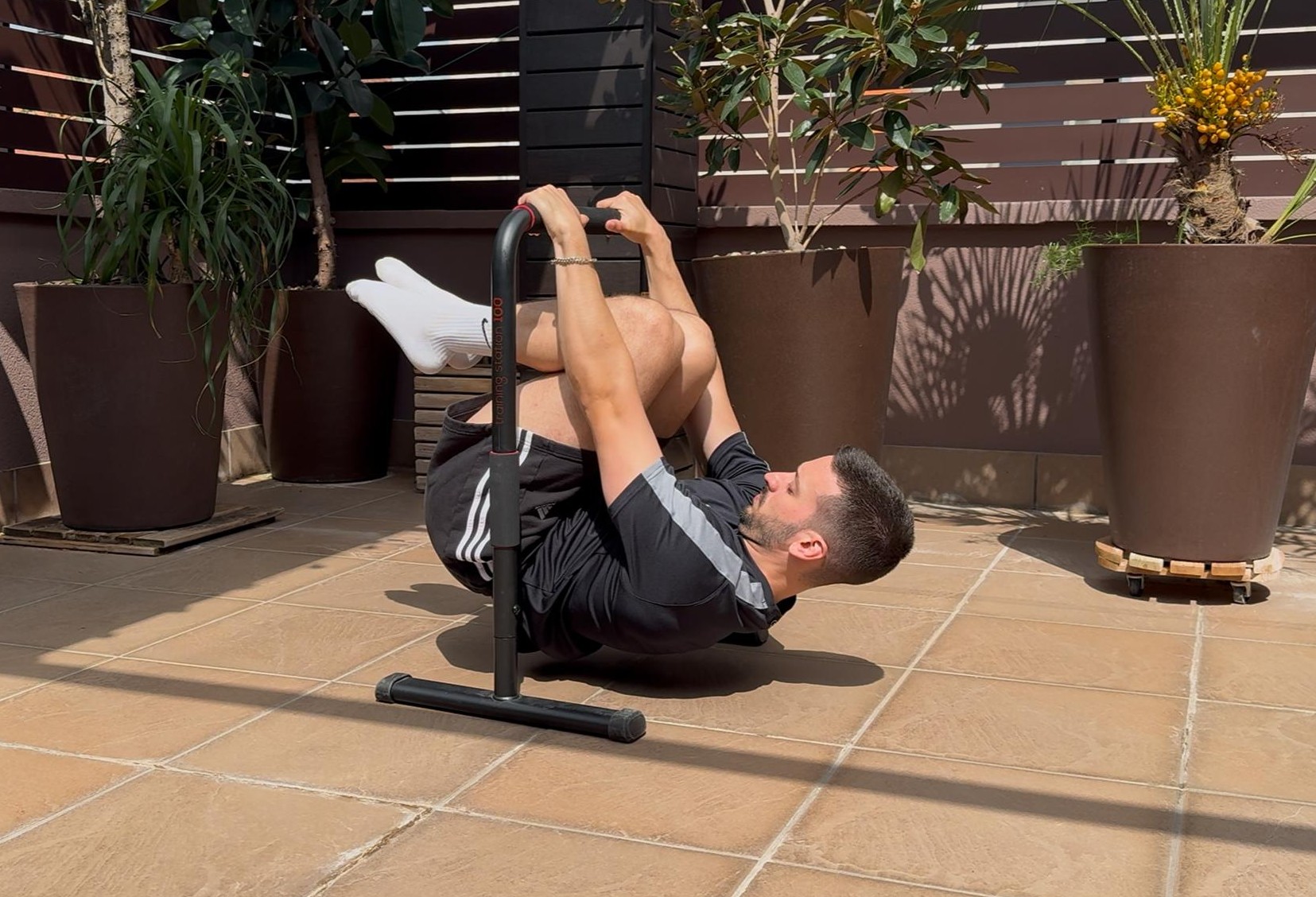
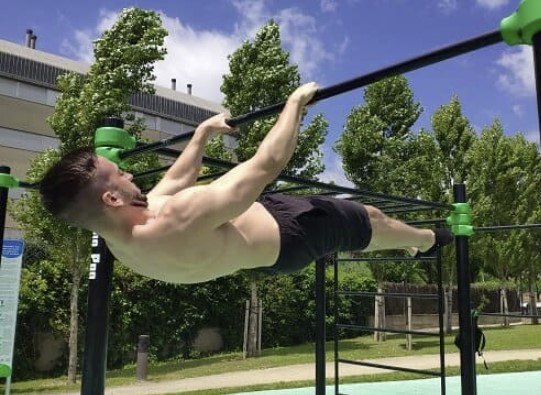
When you modify your body’s posture, you change your center of mass. Moving from an Advanced Tuck Front Lever (knees tucked) to a Straddle Front Lever (legs open in a V) is the exact physiological equivalent of adding more weight in the gym. By moving your legs away from your shoulders, you increase the lever arm, forcing your Central Nervous System (CNS) to send a massive electrical discharge to fire up your fastest and most powerful muscle fibers (Type IIx). If a progression allows you to do 20 repetitions without breaking a sweat or, in this case, hold it for more than 20 seconds “cruising,” the intensity is too low to build strength.
2. Volume: Less “Junk Reps,” More Quality Sets
Volume is the total amount of work you perform in a session (Sets x Reps, or the total accumulated seconds if we are talking about static isometrics). It is the primary variable for building muscle mass, but it has a well-defined limit: junk volume. In high neuromuscular demand calisthenics, effective set volume must be moderate yet flawless. Doing 10 sets of a poorly executed Planche, where you lose the straight line and bend like a banana, is not efficient volume; it’s a tendonitis factory. Your brain memorizes the movement patterns you repeat; if you repeat deformed movements, you will automate poor technique.
The golden rule: Only count sets where you maintain flawless technique (maintaining shoulder protraction, retraction, depression, pelvic posterior tilt… whatever is required depending on the exercise). In calisthenics, volume is measured in accumulated maximum-quality seconds or in repetitions executed at an explosive concentric speed. If the speed or posture drops drastically, the set is over.
3. Frequency: How Often to GET ON the Bar
Frequency is the number of times you train a specific movement or strength pattern per week. In bodyweight strength disciplines, frequency is vital because complex skills require a heavy motor learning (motor learning) component. Your brain needs to practice the “electrical pathway” to learn how to coordinate agonist and stabilizing muscles simultaneously.
However, straight-arm movements subject tendons and ligaments (such as those in the elbow and shoulder) to brutal shear force. Physiologically, muscles receive a large blood supply and adapt quickly, but tendons have barely any blood flow and take up to three times longer to grow strong.
For hyper-complex movements, a Frequency of 2 or 3 (two or three days per week) with a moderate daily volume is the sweet spot for the nervous system to memorize the movement pattern, as long as you leave a minimum of 48 hours of rest between sessions to allow time for the connective tissue to recover and repair.
Conclusion: Stop Eyeballing Your Training
Adjusting volume, intensity, and frequency by eyeballing it or copying a YouTube video routine is like playing Russian roulette with your joints. When you learn to fine-tune these three variables based on your individual levers, plateaus disappear, and exercises or skills start clicking smoothly and pain-free.
Tired of trying generic PDF routines that wreck your elbows and don’t make you progress an inch? In my 1-on-1 Coaching program, we ditch the static templates. I analyze your needs and design a custom-tailored training plan.