
Last modified on April 14, 2026 by Javier González
CALISTHENICS EXERCISES FOR BEGINNERS:
Calisthenics is all about mastering your own body, but not all exercises are created equal, nor do they demand the same from you. Depending on your level, some movements will be the foundation for building strength and technique, while others will push you to your limits and could even lead to injury in the worst-case scenario.
If you’re just starting out, it can be tough to know where to begin. In this guide, you’ll discover the best calisthenics exercises for beginners, based on my experience as a coach and athlete. Master them and use whichever ones you like to build your own routine.
In short, classifying exercises by level allows you to:
- Train safely and progressively, avoiding overtraining and injuries.
- Track your progress, understanding exactly when to move to the next level.
- Optimize your routines: choosing the exercise that will yield the most improvement based on your current strength.
🥇 Calisthenics Exercises for Beginners
If you’re just starting out, your priority should be body control and building overall strength. It’s not about making movements complicated; it’s about mastering the basics. I need you to burn the following table into your memory. In it, you’ll find a list of exercises that every beginner must master to build a solid full-body strength foundation: covering pull, push, core, and lower body.
One downside of calisthenics is that even basic exercises can get tricky. Try to scale them down whenever possible by using resistance bands or a partial range of motion.
| BACK | CHEST | SHOULDERS | CORE | LEGS | GLUTES |
|---|---|---|---|---|---|
|
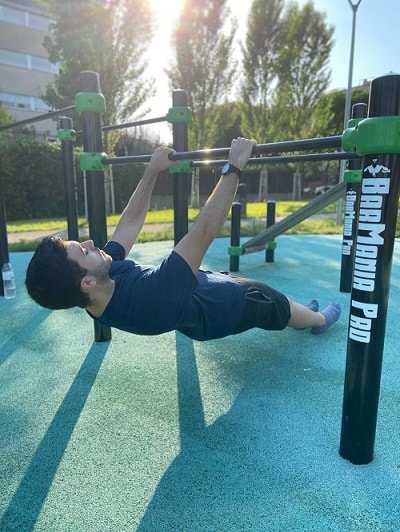
Australian Pull-ups
The best pulling exercise for beginners; it starts building the foundational strength needed for pull-ups. |
Push-ups
The gold standard of pushing. If they’re too tough, you can start with knee push-ups first. |
Decline Push-ups
Once you master standard push-ups, try the decline version (slightly harder). |
Plank
Teaches you core control, which is essential for all advanced movements. |
Squats
The ultimate leg exercise, suitable for everyone. Focus on proper form. |
Glute Bridge
Strengthens the posterior chain and improves stability. Can be done single-legged. |
|
Negative Pull-ups
Excellent for gaining strength within the pull-up range. Control the descent. |
Incline Push-ups
Perfect progression if regular push-ups are still too challenging. |
Resist. Bands
Face pulls, upright rows or T-rows. Ideal for targeting neglected areas. |
Knee Raises
Simple core exercise that progresses toward L-sits or leg raises. |
Bulgarian Squat
Unilateral exercise that requires stability. Great for lower body strength. |
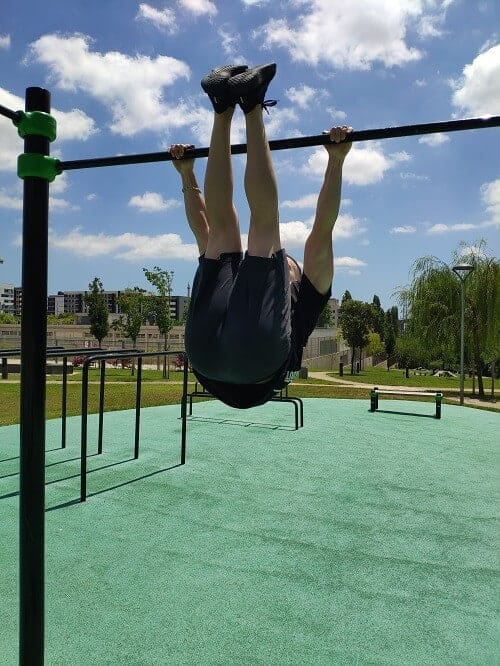
Reverse Hypers
A reverse hyperextension where you lift your lower body instead of the upper body. |
|
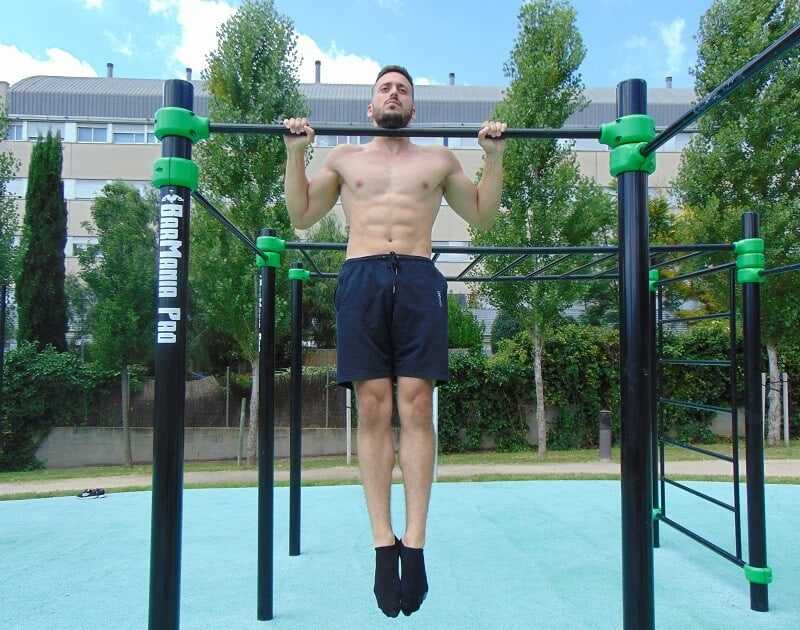
Isometric Holds
Try two positions: chin over the bar or forehead just below the bar. |
Bench Dips
Perfect for building triceps and chest strength before parallel bars. |
Knee Pike P.U.
The premier shoulder exercise and first handstand progression. |
Mt. Climbers
High-intensity exercise for cardio and stable arm lockout strength. |
Calf Raises
Perform unilaterally on a ledge to increase the range of motion. |
Glute Isometrics
Lift one leg past 90 degrees. Glutes and core work to stabilize. |





📌 Coach’s Tip and FAQs
In this phase, prioritize technique and consistency. Don’t train to failure just yet; focus on moving with fluidity and stability. Master these exercises aiming for around 10 clean reps, or 15-second isometric holds before moving on to more advanced levels.
I hope this guide helped you understand how to structure your workouts based on your level. Remember: progression is the essence of calisthenics. It’s not about moving fast; it’s about moving with control and purpose. If you’d like me to dive deeper into a specific level, let me know in the comments. I’ll be publishing full guides for beginner, intermediate, and advanced exercises soon.
Starting calisthenics isn’t about brute strength; it’s about patience and consistency. Master these exercises, train with proper form, and you’ll see yourself progressing toward more complex movements. If you’d like more advanced content, drop a comment and I’ll make sure to get those intermediate and expert guides out to you. In the meantime, put these exercises into practice and build the foundation every athlete needs.
Best!

Leave A Comment